We are a frontier AI lab using neuroscience to help you feel, think and connect in radically new ways. Our first product, ChillsTV, helps you discover content that gives you chills and goosebumps.
ChillsTV
Discover the videos that give you chills, and the ones that give chills to the people you love. Our models predict who gets chills from what.
We have conducted three randomized controlled trials in major depressive disorder, each targeting a different mechanism, and we are working on making a program available by 2028.
Anhedonia and reward learningJournal of Affective Disorders, 2025
Behavioral activationThird trial
Program availableOur goal for 2028
ReWire Studio creates the content in every product
Creator tools
ReWire Studio
Create audiovisual experiences designed to give your audience chills. Our own voice and music models compose every layer, and our chill models show where your audience will feel it.
Novel AI tools still have a long way to go on safety. We conduct research and publish open-access papers to move the field forward and to guarantee the safety of our products.
Not everyone feels chills, and that is normal. In our studies, between 47 and 82 percent of people felt them, depending on the video. ChillsTV is for curiosity and research. It is not a treatment.
A few of the videos on ChillsTV
Every video is a public YouTube video, chosen because it reliably gives people chills. Songs, speeches, film scenes and live moments.
Videos play from YouTube, inside ChillsTV. Titles and thumbnails belong to their creators.
Watch along with strangers.
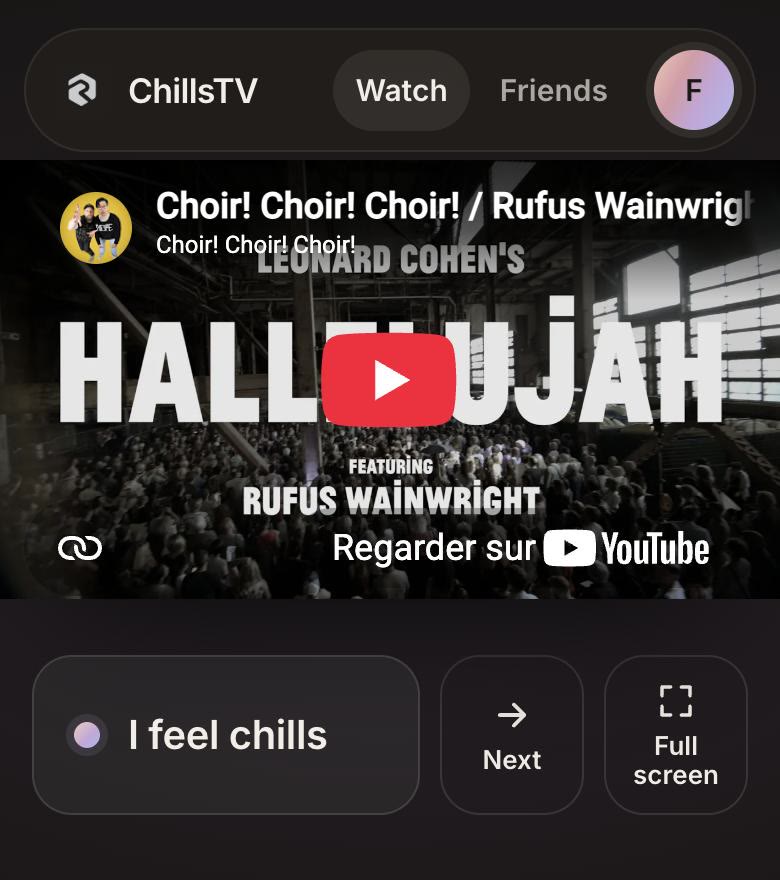
We tested 40 videos on 2,937 people. This performance of Hallelujah was one of the strongest: three in four people who heard it felt chills. In a second study, listeners pressed a button the moment they felt one, and the line under the video shows when. Press play and see whether you feel it too.
The line shows the share of listeners feeling a chill, second by second, over the first five minutes of the performance.
What you get
Videos picked for you
You answer a few questions, and we start with the videos most likely to move someone like you.
Your own collection
Each time you feel a chill, you tap once. Over time you build a list of everything that moves you.
Something to share
Invite a friend and compare the moments that move each of you.
Discover what moves the people you love.
Send a link to a friend, a partner or your sister. When they have watched a few videos, you see the moments that move you both, and the ones that move them that you have never seen.
Gives you both chills
Moves your friend, not seen by you yet
Find the videos that move you.
It takes about four minutes to get your first video.
Our lab studies how the brain, the body and the world around us create experience, and we turn what we learn into friendly products that help people feel great and connect, like ChillsTV, Edge and ReWire Studio.
Today, Netflix, YouTube and ChatGPT do not really know you or understand you. They see your clicks and your words, and they never see how you feel.
We are closing that gap. We are building a loop between your brain, your body and the computers you use every day, so that what you watch, hear and read adapts to you as you experience it. We are building toward moments that feel like “I really needed to hear that”, and that help you progress in life.
Sense
We are making sense of multimodal data, from brain activity, heart, skin and breath to the context a person is in, and we read it through the lens of affective neuroscience.
Understand
We are training machine learning models that turn these signals into predictions, such as how a person will respond to a treatment and which dose fits them.
Respond
We are designing digital experiences that adapt as you go, across video, music, conversation and learning, so that what reaches you fits where you are right now.
To build that future, we first need a state that shows up in the body and the brain and that the environment can reliably trigger. Aesthetic chills, the shiver down the spine you feel during a song, a film or a speech, are exactly that. Over the past decade we have run dozens of studies on chills with thousands of participants. Here is some of what we learned.
1Your body reacts first
We built a neural network that reads heart, skin and breathing signals, and it recognized chills best, 68% of the time, about eight seconds before people noticed them.
2Then you feel it
When strangers listened to the same song, more than a third of them felt a chill at the very same second.
3Your brain becomes less rigid
During a chill, brain activity became less predictable and richer in information, with complexity rising across 41 of 64 EEG channels (effect size 0.55). Read the preprint ↗
4You come away uplifted
Afterwards, people who felt chills reported a far stronger sense of moral elevation (effect size 1.40) and of connection to others (0.82).
ChillsDB is the research kit we built over ten years. It gives laboratories films, songs, speeches and animated scenes that reliably give people chills, timestamped and ready for surveys and body recordings.
The ReWire lab is led by Félix Schoeller and Nicco Reggente in collaboration with the Institute for Advanced Consciousness Studies in Santa Monica, California. Building on hundreds of published research papers in neuroscience and engineering, the lab works with machine learning engineers, neurotechnology enthusiasts and scientific advisors from Harvard Medical School, UC Irvine and UT Tyler.
ChillsDB: an open library of the moments that give people chills
Before ChillsDB, there was no shared set of videos that reliably gives people chills. We built one, tested it on thousands of people, and published the data.
ReWire Research, with MIT Media Lab, Bar-Ilan University, Wellesley College and the Institute for Advanced Consciousness Studies
Researchers who wanted to study chills used to ask participants to bring their own music. That makes studies hard to compare and hard to repeat. We wanted a common starting point that any laboratory could use.
Finding chills in the wild
People often write "chills" or "goosebumps" in the comments under a video that moved them. We searched YouTube and Reddit for those comments and ranked videos by how often people described the feeling. We found 204 videos across music, film and speech, then tested the top 50 on more than 600 people.
From 600 to 2,937 people
For ChillsDB 2.0 we studied 2,937 adults in Southern California, balanced for age, sex, education and political orientation. Each person was randomly given one of 40 clips and told us whether it gave them chills, along with their mood, personality and experience.
Some people feel chills often and others rarely do. In a published study of 2,937 people, a few questions predicted who would feel them 73.5% of the time.
ReWire Research, with the Institute for Advanced Consciousness Studies and MIT Media Lab
If chills are going to be useful, we need to know who is likely to feel them. Using the ChillsDB 2.0 data from 2,937 people, we built statistical models to predict whether a person would report chills from the clip they watched.
What predicts a chill
A model using age, sex, how aroused a person felt before watching, and two short questionnaires predicted whether people got chills with 73.5% accuracy. In that sample, about half of the people reported chills, so guessing would be right about 51% of the time.
Our model73.5%
Guessing51%
This describes that research dataset. It does not forecast how any particular video or product will perform for you.
From paper to product
This research is the reason ChillsTV asks you a few questions before your first video. Your answers shape which videos we show first.
Some of our research involves people with low mood. That makes it important to be precise about what the evidence shows.
ReWire Research
Some of our studies involve people with depressive symptoms or anhedonia, the difficulty of feeling pleasure. In one, published in the Journal of Affective Disorders, 103 adults took part, 59 of them with elevated depressive symptoms. Participants with high anhedonia who had chills showed a larger shift toward rewarding choices than those who did not. These are encouraging research findings.
They are not proof that watching videos treats depression. They come from controlled studies, with specific materials and specific measures, over short periods. That is why we say clearly that ChillsTV and our other products are for curiosity, wellness and research, and that they do not diagnose or treat any condition.
Not everyone feels chills. In our studies, between 47 and 82 percent of people felt them, depending on the video. If you do not feel them, that is normal, and it says nothing about your health or your worth.
Our clinical research program, ReWire DTx, is separate and investigational. No study is enrolling today. If future studies show a benefit, we will publish the results and seek the appropriate regulatory review before making any medical claim.
If you are struggling. ChillsTV is not a crisis service. In the United States you can call or text 988 at any time to reach the Suicide and Crisis Lifeline.
A chill is felt in the body first. People describe a wave of goosebumps, a shiver down the spine or a tightness in the chest. Our 2024 review argues that these bodily sensations are not a side effect. They help shape the emotion itself, as the brain reads signals coming from the body.1
In a lab study at the Institute for Advanced Consciousness Studies, described below, we also recorded heart, skin and breathing signals. A model trained on these signals could tell moments of chills apart from other moments about two times in three. It did best about eight seconds before people pressed the button, which suggests the body starts to change before a person notices the chill.2
What happens in the brain during a chill
Brain scans have shown which deep regions are involved in chills, but they follow changes slowly. EEG records electrical activity at the scalp many times per second. That makes it suited to the few seconds around a chill. Our lab study at the Institute for Advanced Consciousness Studies in Santa Monica used EEG for this purpose.2
In this study, 103 adults from the Los Angeles area came to the lab twice, 10 to 14 days apart. They were 18 to 65 years old and had no neurological or psychiatric diagnosis. In the second visit they listened to three pieces from ChillsDB 2.0, our database of videos and music that give people chills. These were an Aramaic chant, Hallelujah and the Miserere, each about five minutes long.2
We recorded brain activity with a 64-channel EEG cap. Each time people felt a chill, they pressed a small button worn on one finger. We also recorded heart, skin and breathing signals, described above. The study had two randomized arms for a separate question that this page also does not cover. The two arms did not differ in how often people reported chills or in the brain measures below.2
Of the 103 people, 85 reported at least one chill, 14 reported none and 4 had missing data. Hallelujah worked best, with an estimated 90 percent chance of at least one chill. The Miserere followed at 82 percent and the chant at 70 percent.2
Brain signals became more complex
We compared four-second windows just after each reported chill with matched windows from the same piece without a chill. Each chill window started 1.5 seconds after the button press, to leave out the movement of the press. This analysis used the 57 people who reported chills and had recordings clean enough to analyze. It compared 102 chill windows with 102 matched windows.2
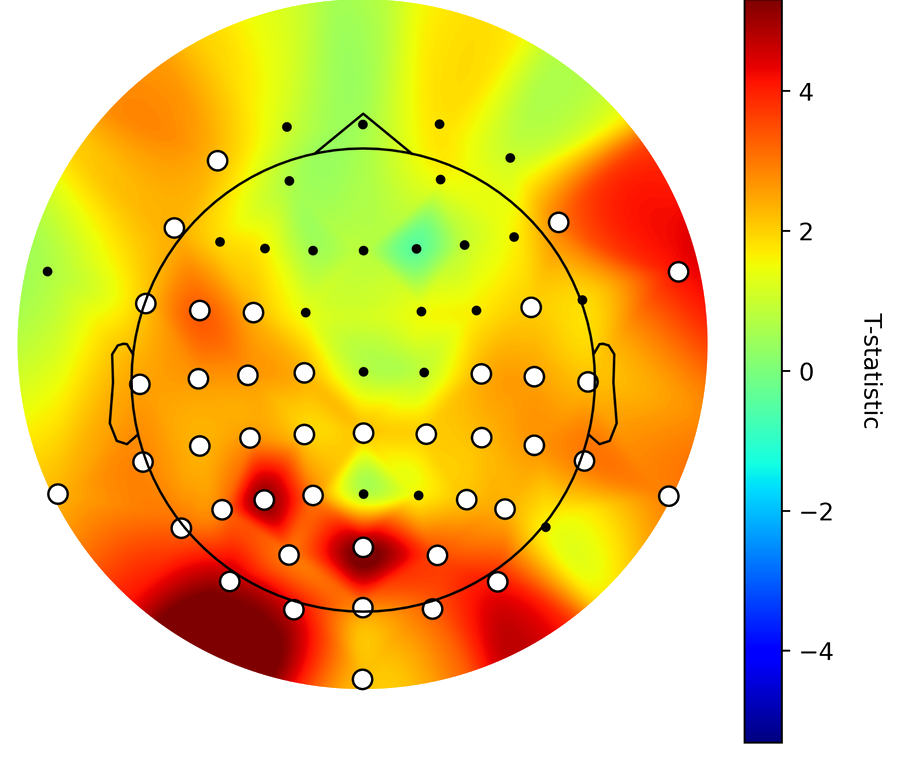
Four measures of signal complexity rose during chills. They were Lempel-Ziv complexity, sample entropy, Higuchi fractal dimension and short-scale permutation entropy. In plain terms, the signal became less predictable and harder to compress. The effects were small to medium, with standardized effect sizes (Cohen's d) between 0.37 and 0.55.2
Change in Lempel-Ziv complexity during chills compared with matched moments without chills, seen from above with the nose at the top. Warmer colours mean a larger increase. White circles mark the 41 channels in the significant cluster.
The figure above maps the change across the scalp. For Lempel-Ziv complexity, the increase covered 41 of the 64 channels after correction for multiple comparisons.2 Five other measures of complexity and criticality did not change reliably.
Brain rhythms shifted toward faster activity
Slow theta rhythms (4 to 8 cycles per second) weakened over 37 channels at the front, center and top of the head. Fast gamma rhythms (30 to 45 cycles per second) strengthened over 27 channels at the back and right side of the head. The ratio of gamma to theta rose across all 64 channels.2
The seconds around a chill
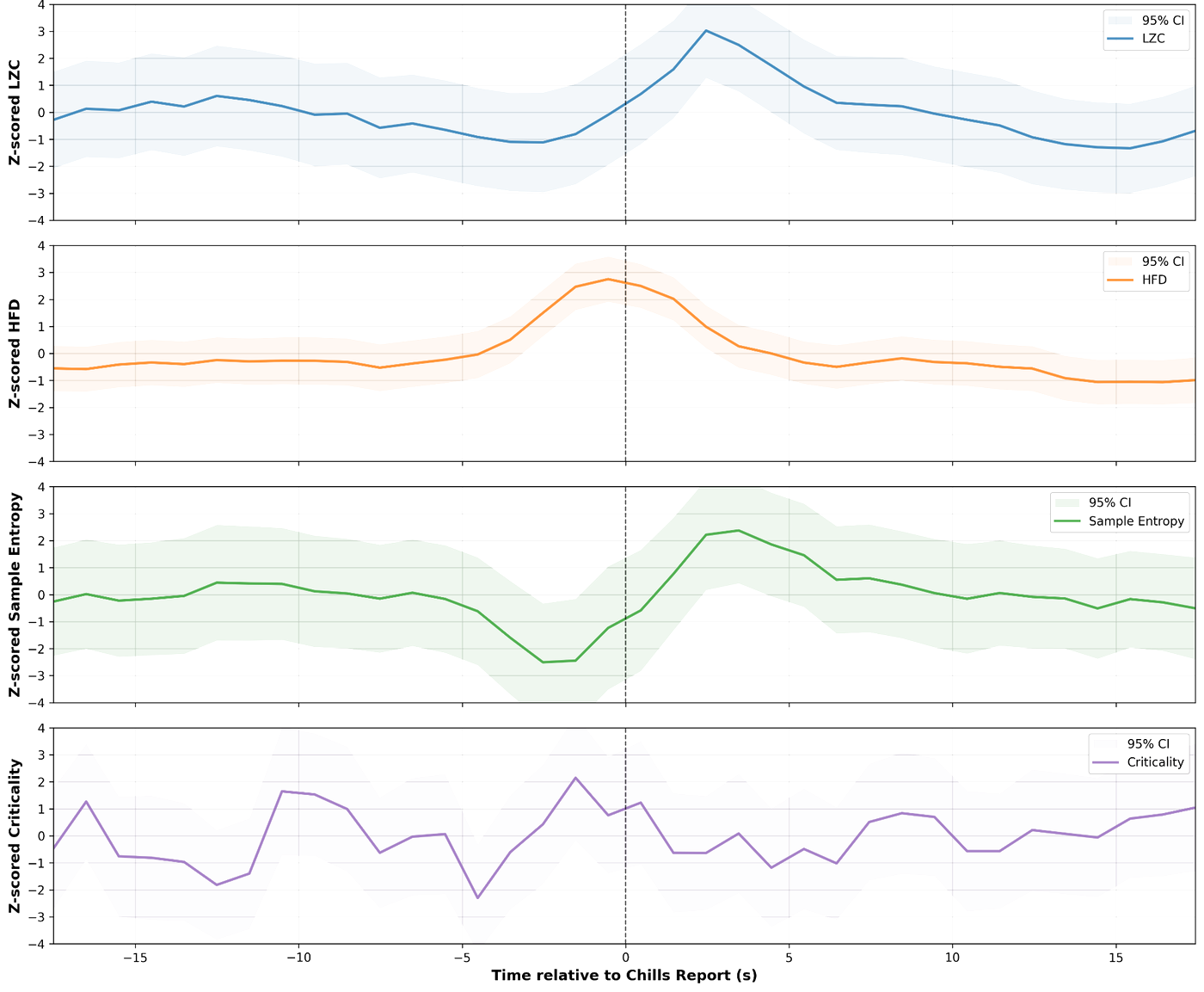
We also followed complexity through the 20 seconds before and after each reported chill. Lempel-Ziv complexity, Higuchi fractal dimension and sample entropy peaked shortly after the button press. Sample entropy dipped briefly just before the press. Criticality, a measure of how close activity sits to the edge between order and chaos, showed no consistent change.2
Whole-head complexity from 17 seconds before to 17 seconds after the reported chill (dashed line), with 95% confidence bands. From top to bottom: Lempel-Ziv complexity, Higuchi fractal dimension, sample entropy and criticality.
What these results can and cannot tell us
These are associations. They show what the brain was doing during chills, not that these changes cause the feeling. EEG measures activity at the scalp, so it cannot show the deep reward regions seen in brain scans.
Fast gamma activity recorded at the scalp can also pick up muscle tension, which the team tried to remove during data cleaning. Chills were timed by a button press, which misses any chill that a person did not report.2
How people feel after a chill
In our EEG lab study at the Institute for Advanced Consciousness Studies, people filled in questionnaires right after listening. Those who reported chills scored much higher than the 14 who did not on moral elevation, the uplifting feeling of seeing goodness in others. They also scored much higher on ego dissolution, a softer sense of the boundary between self and world.2 They scored higher on feeling connected as well.
The effect sizes were large for moral elevation and ego dissolution (d = 1.40 and 1.30). The effect was moderate for connectedness (d = 0.82).2 Differences in psychological insight and emotional breakthrough were smaller and less certain.
Among people who had chills, those who had more of them reported more moral elevation. In the same study, chills did not predict changes in generosity in a money-sharing game. They also did not predict changes on mood and emotion questionnaires or in negative beliefs about oneself.2
These results have limits. The comparison group was small, since only 14 people reported no chills. Two of the three pieces come from religious traditions. All measures were taken right after the session.2
Larger online studies point the same way. In the ChillsDB 2.0 sample, analyzed at the Institute for Advanced Consciousness Studies with Harvard Medical School, people who reported chills, and people whose chills were more intense, scored higher on measures of self-transcendence. This held after accounting for demographics, personality and mood before the clip.3
In the original ChillsDB validation study of more than 600 people, run at the MIT Media Lab and Bar-Ilan University, those who had chills rated their feelings during the clip as more positive and more aroused than those who did not.4 Both of these studies are correlational.
Schoeller F, Jain A, Pizzagalli DA, Reggente N (2024). The neurobiology of aesthetic chills: How bodily sensations shape emotional experiences. Cognitive, Affective, & Behavioral Neuroscience, 24(4), 617-630. doi.org/10.3758/s13415-024-01168-x
Schoeller F, Christov-Moore L, Simonian N, Zuzick S, Shi Y, Jain A, Horowitz A, Kumaravel V, Zhang B, Johnson M, Nath M, Reggente N (2026). Neural correlates and behavioral outcomes of aesthetic chills and their prosthetic augmentation. PsyArXiv preprint. doi.org/10.31234/osf.io/9pu3c_v1
Jain A, Schoeller F, Horowitz AH, Hu X, Yan G, Salomon R, Maes P (2023). Aesthetic chills cause an emotional drift in valence and arousal. Frontiers in Neuroscience, 16, 1013117. doi.org/10.3389/fnins.2022.1013117
A chill is a brief wave of shivers or goosebumps that comes from an emotional moment rather than from cold. Researchers call it a psychogenic shiver.1 Music, film, speeches and stories can all trigger it. Most research looks at pleasant chills, although threatening scenes can cause them too.1
Brain imaging studies by other groups link pleasant chills to the brain's reward system. In a 2001 brain scan study, stronger chills went with changes in blood flow in regions tied to reward, emotion and arousal.2 A 2011 study found dopamine release in the striatum at moments of peak emotional arousal during music.3 In a 2019 drug study of 27 healthy adults, a drug that raises dopamine increased musical pleasure, and a drug that blocks it reduced pleasure.4
Our 2024 review, written by researchers at the Institute for Advanced Consciousness Studies, the MIT Media Lab and McLean Hospital at Harvard Medical School, brings this evidence together.1 It asks how the bodily sensation of a chill shapes the feeling that comes with it.
Where the question started
Our work on chills began with a simple idea. In a 2015 opinion article, written while he was a doctoral researcher at EHESS in Paris, Félix Schoeller proposed that chills mark moments when our understanding of the world suddenly comes together, when something finally makes sense or opens up a new way of seeing.5
Much of this early work was done with the physicist Leonid Perlovsky, whose mathematical theory of the mind describes a knowledge instinct: a drive to make our inner models of the world fit what we experience. Together they proposed that aesthetic emotions, and chills in particular, arise when that fit suddenly improves at the highest levels of meaning, at the edge of what the mind can understand. They applied this idea to stories, where chills tend to come at the moment a narrative resolves,6 and brought it together with experimental tests in a 2018 review of mathematical models of perception, concepts and emotion.7 A later paper extended it to the unconscious emotions that accompany learning.8
Finding chills in the wild
Researchers who studied chills used to ask volunteers to bring their own music. That made studies hard to compare and hard to repeat. ChillsDB was built at the MIT Media Lab and Bar-Ilan University, with the Institute for Advanced Consciousness Studies and Wellesley College, to give laboratories a shared set of tested videos.9
People often write "chills" or "goosebumps" under a video that moved them. The team wrote software that searched YouTube and Reddit comments for those words. It found 204 videos across music, film and speech.9 The top 50 were then tested online with more than 600 people, and ten stood out as the most reliable.9
ChillsDB 2.0, run at the Institute for Advanced Consciousness Studies with the MIT Media Lab, scaled this up. In total, 3,259 adults in Southern California took part, and 2,937 were kept after data cleaning.10 Recruitment quotas balanced sex, age, education and political orientation. Each person was randomly given one of 40 clips, made of 20 stimuli in an audio-only and an audiovisual version. People also answered questions about their mood, personality and reactions.10
What predicts who gets chills
Not everyone gets chills, and that is normal. In ChillsDB 2.0, 1,508 of 2,937 people (51 percent) reported chills from their single clip.11 In our lab study at the Institute for Advanced Consciousness Studies, 85 of 103 people reported at least one chill across three pieces of music.12 Rates depend on the clip, the setting and the person.
Using the ChillsDB 2.0 data, researchers at the Institute for Advanced Consciousness Studies and the MIT Media Lab tested which facts about a person predict whether they report chills.11 Five inputs gave the best result. They were age, sex, how aroused the person felt before the clip, and two short questionnaires. One measures absorption, the tendency to get lost in an experience. The other measures how often a person feels deeply moved.11
With these five inputs, the model predicted who reported chills with 73.5 percent accuracy. About half the sample reported chills, so guessing would be right about half the time.11
This result has limits. The model was trained and tested many times on random splits of the same data. It was also the best of 2,054 combinations of inputs tried on that data, so accuracy in a new group may be lower.
The result describes that research sample. It does not forecast how any product will perform.
Two other patterns stood out. People who felt more aroused before the clip were more likely to report chills. In this sample, men were somewhat more likely than women to report chills.11
Chills also change over a session. In a study at the Institute for Advanced Consciousness Studies and the MIT Media Lab, 58 people each watched six chill-eliciting videos in a random order, and the chance of chills fell as the session went on.13 Among people who still had chills, the chills grew more intense and lasted longer.13
Schoeller F, Jain A, Pizzagalli DA, Reggente N (2024). The neurobiology of aesthetic chills: How bodily sensations shape emotional experiences. Cognitive, Affective, & Behavioral Neuroscience, 24(4), 617-630. doi.org/10.3758/s13415-024-01168-x
Blood AJ, Zatorre RJ (2001). Intensely pleasurable responses to music correlate with activity in brain regions implicated in reward and emotion. Proceedings of the National Academy of Sciences, 98(20), 11818-11823. doi.org/10.1073/pnas.191355898
Salimpoor VN, Benovoy M, Larcher K, Dagher A, Zatorre RJ (2011). Anatomically distinct dopamine release during anticipation and experience of peak emotion to music. Nature Neuroscience, 14(2), 257-262. doi.org/10.1038/nn.2726
Ferreri L, Mas-Herrero E, Zatorre RJ, et al. (2019). Dopamine modulates the reward experiences elicited by music. Proceedings of the National Academy of Sciences, 116(9), 3793-3798. doi.org/10.1073/pnas.1811878116
Schoeller F (2015). Knowledge, curiosity, and aesthetic chills. Frontiers in Psychology, 6, 1546. doi.org/10.3389/fpsyg.2015.01546
Schoeller F, Perlovsky L (2015). Great expectations: Narratives and the elicitation of aesthetic chills. Psychology, 6(16). doi.org/10.4236/psych.2015.616205
Schoeller F, Perlovsky L, Arseniev D (2018). Physics of mind: Experimental confirmations of theoretical predictions. Physics of Life Reviews, 25, 45-68. doi.org/10.1016/j.plrev.2017.11.021
Schoeller F, Jain A, Horowitz AH, Yan G, Hu X, Maes P, Salomon R (2023). ChillsDB: A gold standard for aesthetic chills stimuli. Scientific Data, 10, 307. doi.org/10.1038/s41597-023-02064-8
Schoeller F, Christov-Moore L, Lynch C, Reggente N (2023). ChillsDB 2.0: Individual differences in aesthetic chills among 2,900+ Southern California participants. Scientific Data, 10, 922. doi.org/10.1038/s41597-023-02816-6
Schoeller F, Christov-Moore L, Simonian N, Zuzick S, Shi Y, Jain A, Horowitz A, Kumaravel V, Zhang B, Johnson M, Nath M, Reggente N (2026). Neural correlates and behavioral outcomes of aesthetic chills and their prosthetic augmentation. PsyArXiv preprint. doi.org/10.31234/osf.io/9pu3c_v1
Schoeller F, Christov-Moore L, Lynch C, Jain A, Diot T, Reggente N (2025). Repeated exposure decreases aesthetic chills likelihood but increases intensity. PLOS ONE, 20(4), e0300494. doi.org/10.1371/journal.pone.0300494
Some of our studies include people with depressive symptoms or anhedonia. Anhedonia is a reduced ability to feel pleasure. It is one of the two core symptoms of major depression, and it is linked to poorer response to treatment.1 Because chills involve the reward system, we asked how they relate to reward learning and to beliefs about oneself in these groups.
These are research findings with clear limits. None of them shows that watching videos treats depression.
Beliefs about oneself
This study, run at the MIT Media Lab and the Institute for Advanced Consciousness Studies with colleagues in Paris, recruited 96 adults online. All reported a past diagnosis of depression by a physician. In a single session, each person watched one of two videos from ChillsDB and answered questionnaires before and after.2
People who reported chills scored higher on self-acceptance than people who did not (p = .003). Self-acceptance was one of five self-belief scales tested, and it was the only one that differed. People who had chills also reported more emotional breakthrough.2
The study compared people who did and did not have chills, so it cannot show cause. It relied on self-report, and there was no clinical interview at the time of the study. It was also a single session.2
Reward learning
This study, run at the MIT Media Lab and the Institute for Advanced Consciousness Studies with McLean Hospital at Harvard Medical School, included 103 adults recruited online. Of these, 59 had elevated depressive symptoms, and 26 of the 59 had high anhedonia. A comparison group of 39 people had no elevated symptoms.3
Everyone played a simple computer game before and after watching one short video. In the game, one of two answers is secretly rewarded more often, and people usually learn to favor it over time. People with anhedonia often show less of this learning.3
High-anhedonia participants who experienced chills showed a larger shift toward rewarded choices than those who did not (p = .004).3 There was no such difference in the low-anhedonia group. The high-anhedonia group was small, with 13 people who had chills and 13 who did not.
Chills were not assigned at random, because some people simply had them and others did not. Learning was measured only right after a single video.3
What this research does not mean
ChillsTV, Edge and ReWire Studio are consumer wellness products. They are not treatments. They do not diagnose, treat or prevent depression or any other condition. The studies on this page used research stimuli and study tasks, and their results do not describe how any product performs.
ReWire DTx is a separate research program. It is investigational, it is not available and it has not been reviewed by FDA. Its effects have not been established. We are planning future studies, and none is enrolling today.
If you are struggling. Our products are not a crisis service. In the United States, you can call or text 988 at any time to reach the Suicide and Crisis Lifeline.
What we still do not know
Whether chills cause the changes linked to them, or only go along with them.
Whether any change lasts beyond a single session. Most measures above were taken within minutes of listening.
How the findings apply to people who rarely get chills. Only 14 people in our lab study reported none.
Whether the results hold outside the United States. Most samples above came from the United States.
Whether the EEG pattern repeats in an independent sample, and with music that does not come from a religious tradition.
We will update this page as papers are published or corrected.
Ostinelli EG, Salanti G, Macleod M, et al. (2025). Pro-dopaminergic pharmacological interventions for anhedonia in depression: a living systematic review and network meta-analysis of human and animal studies. eBioMedicine, 121, 105967. doi.org/10.1016/j.ebiom.2025.105967
Schoeller F, Jain A, Adrien V, Maes P, Reggente N (2024). Aesthetic chills mitigate maladaptive cognition in depression. BMC Psychiatry, 24, 40. doi.org/10.1186/s12888-023-05476-3
Jain A, Schoeller F, Esfand S, Duda J, Null K, Reggente N, Pizzagalli DA, Maes P (2025). Aesthetic chills modulate reward learning in anhedonic depression. Journal of Affective Disorders, 370, 9-17. doi.org/10.1016/j.jad.2024.10.038
Aesthetic chills have garnered increasing interest from researchers investigating their neurobiology and genetic basis. As a result, a growing number of scientists are looking to reliably induce chills in laboratory settings. Over the past ten years, our team has developed the scientific instrumentation to do exactly this. Today, we are making these tools freely accessible to researchers worldwide so that together, we can discover something new about consciousness and cognition.
Somatic Marker Validation
Data Sourcing Methodology2.8M+
Comments analyzed across social media. Clips were sourced by scanning for self-reported somatic markers to establish a baseline elicitation probability prior to lab validation.
Top Sourced Stimulus
Total Comments
Somatic Markers
Ed Sheeran - Give Me Love
91,597
479
Hans Zimmer - Time (Inception)
40,173
432
Lana Del Rey - Once Upon A Dream
16,871
291
The Great Dictator Speech - Chaplin
17,633
215
The Library
Modality 01
Music
12 Stimuli
Includes live vocal performances, classical choral pieces (e.g., Allegri's Miserere mei, Deus), orchestral movie scores (Interstellar, Gladiator), and acoustic covers.
Modality 02
Films
22 Stimuli
Features specific climactic cinematic scenes, including battle sequences, character reveals, and emotional peaks (e.g., Jurassic Park, The Hobbit, Inception, Rocky).
Modality 03
Speech
22 Stimuli
Includes film monologues (The Great Dictator, Scent of a Woman) and real-world motivational addresses (Admiral McRaven, Denzel Washington, Rick Rigsby).
Modality 04
Anime
08 Stimuli
Specific scenes from animated series (Naruto, Dragon Ball Z) featuring high-stakes narrative moments, character sacrifices, and synchronized musical scores.
Protocol Integration
Compatible out-of-the-box.
Stimuli are provided in standardized formats with precise timestamping for event-related designs. Easily deployable across behavioral surveys and neuroimaging environments. Request the free kit to get the full metadata files and media package.
These capabilities operate on top of the standard ChillsDB toolkit as an API integration. We charge a small implementation fee for API access and compute, though sponsored credits are available for academic labs.
Prediction EngineMatch participants to chills stimuliCo-developed with IACS
Our machine learning model evaluates participant inputs (personality, music-reward sensitivity, state affect) to calculate individual elicitation probabilities. Based on our predictive models published in PNAS Nexus, this API allows researchers to dynamically select the highest-yield stimulus per individual subject during an experiment.
Generative PipelineCreate unique personalized stimuliOffered by ReWire Neurotechnologies, Inc.
A separate generative pipeline capable of synthesizing bespoke, multimodal speech stimuli on demand. The system is engineered to target specific individual reward sensitivities and optimize the probability of eliciting a psychogenic shiver in real-time without relying on pre-existing library clips.
Publications & References
The ChillsDB kit is built upon the following peer-reviewed literature and open-source datasets. We ask that researchers utilizing the kit cite the relevant papers below.
Create personal meditations that run on Edge and share them as a link. Each one is written for one listener and comes back finished, with a voice and music. Built for therapists, storytellers and meditation teachers.
Money. I make enough now, but I still check my account three times a day and I can’t buy anything without feeling guilty.
Write an answer for me+ Add question
▸ VoiceSarah · warm, slow
▸ MusicFirst Embers · 12:10
▸ Mix[pause] 3 s · [long pause] 6 s
SaveGenerate text
Enough money#14Edit text
Somewhere in your day there is a small gesture you repeat. A hand reaching for the phone. A number appearing on a screen. You know it well. Let it appear now, and do nothing about it. [pause]
Notice where in the body the checking begins. Perhaps the chest. Perhaps the stomach. A slight tightening, a leaning forward. Stay with the place itself and let the number fade. [long pause]
Now imagine the account as a room. It is small. There is a table, and on the table there is enough. Walk around it once, slowly. Touch the edge of the table. [pause]
▶
9:42Copy link for your client
Clinical research · investigational
ReWire DTx
A digital therapeutic in development for depression and anhedonia.
ReWire DTx is our clinical research program. It studies whether structured experiences that give people chills can help people who struggle to feel pleasure, building on our published research on reward learning and self-beliefs. It is investigational, it is not available, and it has not been reviewed by FDA. ChillsTV, Edge and ReWire Studio are wellness products and are not part of it.
It is investigational, it is not available, and it has not been reviewed by FDA. ChillsTV, Edge and ReWire Studio are wellness products and are not part of it.
Free$0foreverAvailable nowFind out what gives you chills and explore our research.
Member$14.99per monthor $99 per yearPreorder · launches 2027Content made for you by ReWire Studio, plus Edge to create and share your own meditations.
EnterpriseCustomon requestAvailable nowReWire Creator Tools: everything you need to design and deliver your own experiences, in any medium, for clients, patients or audiences.
ReWire Creator Tools: build personalized meditations, guided journeys, films, rituals and any other kind of experience for the people you serve
Our proprietary and fine-tuned models
Admin console to manage your clients and listeners
Publish on Edge under your own name
Seats for your team and dedicated support
Team
The people behind ReWire.
Founders, scientists, engineers, clinicians and creators building technologies to help people feel good and connect in radically new ways.
Félix Schoeller, PhDFounder and CEO
Serial entrepreneur building companies in AI and mental health technology.
Read bio
Félix Schoeller is a repeat founder and the CEO of ReWire. He co-founded BeSound, a wearable that turns body movement into music in real time, designed to help people recovering from trauma and PTSD. He co-founded Nested Minds, whose AI artist Huxley created the music video for Duran Duran’s Invisible in 2021. At the Fireside Project he directed Fireside Lab and was the primary architect of the AI model behind Lucy, a voice simulation that trains psychedelic support facilitators. He holds a PhD in cognitive science from EHESS in Paris, was a research affiliate at the MIT Media Lab, and has published more than 40 peer-reviewed papers, many of them on aesthetic chills. His work has been featured in Nature, VICE and Rolling Stone.
Nicco Reggente, PhDCofounder · Director of Neuroscience
UCLA neuroscientist and research director of a consciousness institute.
Read bio
Nicco Reggente is a cofounder of ReWire and its Director of Neuroscience. A cognitive neuroscientist, he earned his PhD at UCLA as a National Science Foundation Graduate Research Fellow and now teaches functional neuroimaging there as a lecturer. He is also the research director of the Institute for Advanced Consciousness Studies, a nonprofit lab in Los Angeles, where he leads a team of five and is principal investigator on grants from the Tiny Blue Dot Foundation, the Bial Foundation and others. His research combines brain imaging, EEG and machine learning to study meditation, aesthetic chills, memory and empathy. He was lead author of a 2018 PNAS paper showing that resting-state brain connectivity predicts response to cognitive behavioral therapy for obsessive-compulsive disorder. With Félix he co-authored the ChillsDB 2.0 dataset and a PNAS Nexus study predicting who gets chills. He has published about 40 peer-reviewed papers. Outside the lab, he is a disc golf enthusiast.
Ashwin MuraliMember of Technical Staff
Machine learning engineer, expert in deep learning and voice models.
Read bio
Ashwin Murali is a machine learning engineer and an expert in deep learning, time-series forecasting and voice models. At the Fireside Project, he worked with Félix on the voice models behind a simulation that trains psychedelic support facilitators. Before that, he built data systems for enterprise clients at Accenture. He holds an MSc in Data Science and Artificial Intelligence with Distinction from the University of Liverpool. In his free time, he is a cricket fan and player.
Diego A. Pizzagalli, PhDScientific advisor
Leading expert on anhedonia and reward, founding director at UC Irvine.
Read bio
Diego Pizzagalli is a global authority on the neurobiology of anhedonia and reward processing and ranks among the most cited researchers in depression. He is the founding director of the Noel Drury, M.D. Institute for Translational Depression Discoveries at UC Irvine and the former director of the Center for Depression, Anxiety and Stress Research at Harvard Medical School, where his research defined the field’s understanding of reward system dysfunction. He created the Probabilistic Reward Task, the standard instrument for quantifying blunted reward learning in clinical populations and a core mechanism the ReWire platform aims to address, and he is a coauthor with the ReWire founders on the peer reviewed publications establishing the mechanism behind the platform.
Kim C. Willment, PhDScientific advisor
Harvard Medical School neuropsychologist and founder of a resilience program.
Read bio
Kim Willment is a board certified neuropsychologist, an assistant professor at Harvard Medical School, and the founder and director of the RENEW Program for resilience through neurological and emotional wellness at Brigham and Women’s Hospital. She has spent two decades pioneering the clinical implementation of non pharmacologic interventions for neurological populations, and her expertise in neuropsychological assessment and rehabilitation guides the translation of ReWire’s embodied digital therapeutics from laboratory protocols into real world clinical workflows. She sees ReWire as a tool for both patients and clinicians that helps people reconnect with more expansive, adaptive ways of experiencing themselves and the world.
Adam McGuire, PhDScientific advisor
Clinical psychologist leading federally funded trials on positive emotion.
Read bio
Adam McGuire is an associate professor of psychology, a licensed clinical psychologist, and a leading researcher on veterans’ mental health and trauma related disorders. As a federally funded principal investigator he leads clinical trials on positive emotion induction, specifically moral elevation, to treat trauma and comorbid depression, and his expertise in digital affect exposure and trial design for high acuity psychiatric conditions keeps ReWire’s therapeutics grounded in evidence based practice for complex mental health populations.
ReWire DTx is an investigational research program. It studies whether experiences that give people chills could one day help people with depression and anhedonia, the difficulty of feeling pleasure. It is not available and has not been reviewed by FDA. ChillsTV, Edge and ReWire Studio are wellness products and are not part of it.
What the research shows so far
These are early research findings with real limits. They do not show that any product treats depression.
Journal of Affective Disorders, 2024
In a study of 103 adults, 59 with elevated depressive symptoms, participants with high anhedonia who had chills showed a larger shift toward rewarding choices than those who did not.
What comes next
We intend to register any future study, run it under ethical review and publish the results, whatever they are. We will not make a medical claim without the appropriate regulatory review.
No study is enrolling today.
Clinicians, researchers and funders can leave their details to hear when we plan future studies.
If you are struggling, please contact a health professional. In the United States you can call or text 988 at any time to reach the Suicide and Crisis Lifeline.
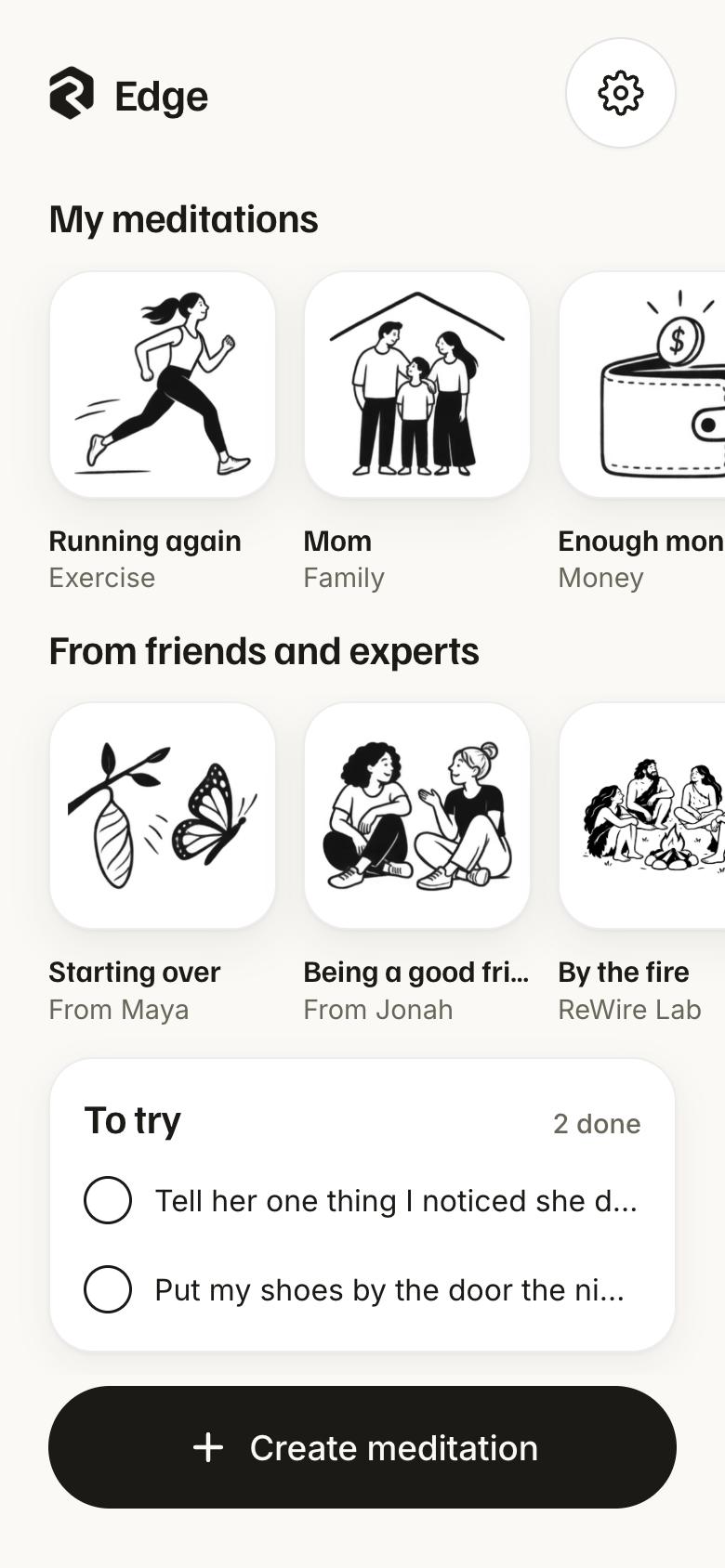
Edge is a behavioral activation app. Create and share personalized meditations about your own life, designed to bring on chills, self-transcendence and peak experiences.
Create an account or sign in, and you are on the list. We will tell you the price before you pay anything.
Questions
How is it personal?
You tell Edge what is on your mind, in a few words. Each meditation is made for you, about your own situation.
What if I don't get chills?
Some people feel chills and some do not. That is normal, and it says nothing about you.
Is this a treatment for depression?
No. Edge and ChillsTV are wellness products for reflection and emotional wellbeing. They are not medical devices, have no FDA clearance, and do not treat any condition. ReWire DTx is a separate, investigational research program.
When can I use it?
Edge launches in January 2027 in the United States. Preorder the membership and we will email you when your access is ready.
ReWire Studio lets anyone create personal meditations that run on Edge and share them as a link. You get a finished experience, written for one person and recorded with a voice and music. It is designed for therapists, storytellers and meditation teachers.
Answer the question, then generate the text. It appears here, and you can mark it up and edit it.
Generate mp3
Recording voice and mixing music…
3:24
ReWire Studio, as you would use it. Press play to hear a real sample exported from ReWire Studio. Your client gets a link that opens on any phone.
Everything you need to make one meditation for one person.
Start from a short brief
Answer one or two questions about your listener, in your own words. ReWire Studio turns them into a script written for that person.
30 guided primers
Start each experience with a three-minute primer to settle the body: somatic, breath, attention, compassion, induction or reflection.
A script you can shape
Edit every line, and place pauses and long pauses exactly where you want silence to land.
Voice and music
Pick a natural voice and a music track, and ReWire Studio mixes them with your script into one finished recording.
Versions you can compare
Every generation is saved. Listen side by side, mark the best one and keep refining.
Shared under your name
Send a link that plays on Edge, or download the audio. Your listener sees who made it for them.
Length
2 to 7 minutes, plus an optional 3-minute primer
Primers
30, in six families
Output
A link that plays on Edge, or an mp3
Editing
Full script editing with pause marks
Library
More than five million words of wisdom and technique
Built against AI slop.
Generic AI writes generic meditations. We fine-tuned our models on a wisdom corpus of more than five million words, curated by PhDs, and on the techniques of guided imagery, hypnosis, breathwork and somatic practice. The result reads like a skilled guide wrote it for one person, because that is what it was trained to do.
Wisdom 1.27MSelf-compassion 1.26MAwe and the sublime 595kGuided imagery 464kNature and landscape 363kScience and wonder 248kHypnosis 227kPoetry 159kSupplementary readings 533k
Words per library.
Make your first experience.
ReWire Studio is open by invitation. Tell us who you work with and what you want to make, and we will set you up.
ReWire Studio is a wellness and research tool. It does not provide medical or psychological care.
Create your ReWire account
First you create an account or sign in, then you answer a few quick questions, and then you preorder the Edge membership on a secure page. Nothing is charged until we launch.
From your home screen, ReWire opens straight into ChillsTV and tells you when a friend’s chills match is ready.
Tap Share in Safari. You find it at the bottom of the screen, or inside the ••• menu.
Scroll down, tap Add to Home Screen, then tap Add.
Open ReWire from your home screen and sign in once with the same email.
Open the browser menu ⋮ at the top right.
Tap Install app or Add to Home screen.
Open ReWire from your home screen.
Point your phone camera at this code. It opens this page on your phone with the steps for iPhone or Android.
Before you begin
Important notice. ReWire, including ChillsTV and the ReWire app, is a wellness and research service. It is not a medical device, and it does not provide medical or psychological advice, diagnosis, or treatment. It is not a substitute for care from a qualified health professional. If you are in crisis, or thinking about harming yourself or someone else, do not use this service. Contact your local emergency number or a crisis line right away.
Please confirm
Preorder the ReWire membership
Your membership gives you access to:
Edge, our app for personal ten-minute meditations designed to bring on chills and peak experiences.
Meditations you create and share with the people you care about.
First access to what we launch next, and to our events.
This is a preorder. Nothing is charged until we launch, and you get a free trial before you decide. Your answers on the next pages help us build it for you.
We will email you as soon as Edge is ready, which we expect in January 2027. Until then, ChillsTV is yours to explore.
Let’s find what gives you chills.
In the next two minutes, we will ask you a few questions about yourself, then match you to the video most likely to give you chills. There are no right answers so go with your first reaction.
In our studies, about three in four people get chills from the first video. If you don't, that is common and says nothing about you. You can try another.
That happens to about one in four people on their first video, and it says nothing about you. Chills often come from the video you least expect, so try another one whenever you like. Thank you for your answers; they count toward the research.
Welcome to ChillsTV.
Here you can watch hundreds of videos that have been validated to give people chills. The more you tell us about what you like, the easier it becomes for us to find your chills.
Tap “I feel chills” whenever you feel one, and we will do the rest.
Edge launches in January 2027.Become a member and be among the first to use it.
Your chills score
No chills so far. That is common and says nothing about you. Chills often come from a different video than the first, so keep watching.
Play with your chills.
1 of 2
Game
Chills compatibility
Find out how compatible you are with your friends, and discover the videos that give you both chills.
?
?
Game
Beat the algorithm
Pick a video for a friend. If it gives them chills, the point is yours. If the algorithm's pick does better, the point goes to the machine.
?
You0
Algorithm0
Contribute to the science
What gives you chills?
A song, a speech, a scene, a link, a memory. Anything you send goes to our research lab, where it improves ChillsDB and shapes our next studies.
Coming soon
Edge by ReWire
Launches Q1 2027
Edge makes ten minute audio sessions about what gives you chills. A voice and music, written for you, bring the feeling back and open a new way of seeing your own life.
Sessions written for you, each one building on the last
Experiences by the ReWire lab and the experts we work with
Your chills videos and your friends, from ChillsTV
Edge makes ten minute audio sessions about what gives you chills. A voice and music, written for you, bring the feeling back and open a new way of seeing your own life. It also carries meditations designed with world experts.
ChillsTV is a free test that tells you how easily you get chills, those shivers and goosebumps that certain songs, films, and moments can set off, and which videos are most likely to give them to you.
Find out whether you chill together. Send one link to anyone, a friend, a partner, your sister. They take the short test, and the moment they finish, your result opens for both of you at the same time.